1984: Learning to Pretend, to Empathize, and to Love

image

(If you want to know why I am talking about 1984, I explained myself yesterday)

There is a concept in media studies called monoculture. The name explains the idea to some degree, but this Salon piece offers a more precise definition if you’re interested. TV and music have become highly personalized experiences these days. Unless it is a massive event like the Oscars or the Super Bowl, people just don’t watch things live anymore, so there is no real communal experience.

Movies are the last real holdout of monoculture. Sure, there are more movies now than ever thanks to technology, but studio slates are still relatively small and consist mostly of tent pole pictures, the big budget action movies like Avengers that need to gross a billion dollars in order to recoup costs and fund the studio for the next year.

But every once in a while there is a not so big film that develops a cult following in the rental (I guess now the better term is streaming) space. Such was the case with the 1984 fantasy film The Neverending Story. Yes, it was a hit in the theaters, grossing over $100 million back in a time where that feat was still impressive.

But this existential sci fi film so fantastical and psychologically based it could only come from the minds of the Germans continued its success on home video. A German book that was unique in that it was printed in different colored inks to signify what was the book and what belonged to a book within the book, it was directed by German-born Wolfgang Peterson.

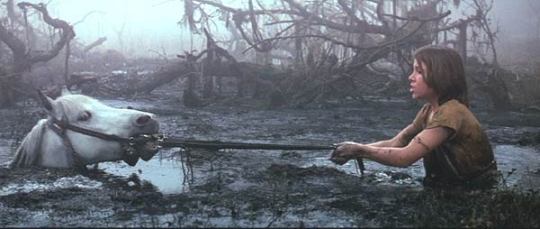
Really, could anything but German Expressionism be responsible for the sequence in the film when the fantasy’s hero of the book within the book Atreyu loses his beloved horse, Artex? If you’re not familiar, let me set the scene. Atreyu and his steed are riding through the Swamps of Sadness, which literally can overcome you with a melancholy so heavy you sink into the sludge. While brave Atreyu managed to fight the negativity, his white horse could not and, despite Atreyu’s best efforts, he dies:

In elementary school, I cited this as the saddest scene in film history, as did most of my peers. It wasn’t specific to Lexington either. I asked my cousin Mollie, who is a year older than me and grew up in Memphis, what part of Neverending Story she most remembered (awesome theme song excluded).

“Oh, when the horse died. So traumatic.”

In retrospect, the proliferation of clinical depression in people my age might help to explain why as kids this scene stuck with us.  As kids, we fear the villain of the movie, The Nothing, the idea that our wildest dreams and imaginations could disintegrate, leaving us living in a vast void all by ourselves. We rely on our imagination and books to fill those empty spots in our everyday lives. We start to develop the sense that the sadness in our life might get so overwhelming we can’t go on, and it is a fear that tends to grows stronger the older you get.

As an adult, I rewatch that scene through an entirely different lens, realizing this movie may have been the first thing that helped me understand what depression was. You watch your friend slowly sinking into the swamp seemingly indifferent to saving themselves while you pull and scream and do anything you can to get them to snap out of it to no avail.

It also helped to instill a sense of empathy, as I cried along with Atreyu at the thought of losing his friend. Yes, it made me sad to see, but I loved the movie for being so powerful as to make me care about someone else’s horse, especially a someone else who didn’t even exist.

I was really big on pretending as kid, so imaginary friends and fictional characters were par for the course, really. I could entertain myself alone in the backyard for hours, turning my swing set into a spaceship racing along with the Hanna Barbera cartoons or My Little Ponies’ castle. I spent a disproportionate amount of my youth in front of a television, but when I look at my nephews, I realize a lot more of my childhood involved playing pretend than theirs does.

If there was a show of my childhood that embodied the power of pretending and imagination the way The Neverending Story did, it would be Muppet Babies. The show premiered in 1984, just two months after Muppets Take Manhattan featured a dream sequence of baby Muppets dancing about a nursery.

In the show, the nursery was rarely the nursery though. Instead, it was a pretend spaceship, a pretend dude ranch, or a pretend newspaper:

The way Muppets pretended was very similar to the way I did. We would take some piece of cultural and basically perform fan fiction, elaborating where the story left off. It is a cultural creation strategy that has grown beyond pretending in the backyard to pretty much how all non-original TV shows and movies are made. In film criticism, the term is “pastiche”, which is taking a lot of elements from other pieces of culture and slapping them together, relying on the appeal of the artifacts to make the new piece interesting (like this). Quentin Tarantino does this, and it is the source of the greatest praise and the greatest criticism of his work.

This is classified in cinema as postmodernism, which is characterized by throwing back to older works, often blending a number of genres together, smashing high art into low art. It is very common in blockbuster movies, but it can apply to other things too, like music.

The Billy Joel concept album An Innocent Man is a great example of postmodernism in music. The album, which includes songs like Uptown Girl and Leave a Tender Moment Alone, is intentionally crafted to sound like songs from the 50s and 60s even though it was released in the 80s. It works because, sure, people are always intrigued by new, interesting sound people also like what they know.

It was the 90s by the time I discovered the Billy Joel song The Longest Time, but I loved it nonetheless. As someone who missed a lot of the 80s because my parents never listened to contemporary music, Billy Joel was off my radar for a long time. But once I started listening to music made after 1970, An Innocent Man was the album I latched onto first. I think of Joel as the bridge between a childhood of growing up on oldies music and an adult life of liking more modern music, preferably performed by a soulful dude with a piano.

It is a beautiful thing to fall in love with a song, which is exactly what happened with The Longest Time. It is an interesting thing to fall out of love with one though. I cited this as my favorite song for several years, until a friend of mine and her husband (who I was always rather critical of) decided it was “their” song. They also walked down the aisle to Ben Folds’ “The Luckiest”, another piano tune I spent much of college completely obsessing over.

There are certain things that, once associated with a song, you just can’t get past. We’ve all had a “song” with a boyfriend or girlfriend that becomes too painful to listen to for a while (it is another story for another time, but there was a year where I couldn’t listen to VeggieTale’s “His Cheeseburger” without crying). That is how I feel about The Longest Time and The Luckiest now. These were two songs I loved to listen to, imagining a life with my husband in which we shared the sentiments of these songs in the grown up version of pretending–daydreaming. While it is not a break up, knowing these songs were tied so closely to a relationship I wasn’t particularly fond of ruined my ability to pretend when listening to them, in turn ruining the songs not for any artistic reason, but because life decided it was time to change the playlist. It was too real, too tied to something I didn’t like much at all. Funny enough, I have since come around on the relationship, but the song continues to be one I just can’t listen to, nor will I be able to for quite a long time.

Scoring My Life Archive

1983: Return of the Jedi, Taxi, Faithfully

1983: A Fateful and Faithful Beginning

(For an explanation of this year-by-year cultural exploration, check out this introductory blog post)

I just missed out on being born in one of those easy-to-remember, apt to be culturally compared years when I came into the world late in September 1983, missing out by just three months on a whole lifetime of Orwellian comparisons. According to most generational groupings, 1982 is the cutoff for being a Snake Person, but let’s be honest. If you call me a Snake Person, I will poke you in the eye.

I prefer the generational designation determined by Barney Stinson of How I Met Your Mother fame. He calls it the Ewok Line. The line exists exactly ten years before the release of Return of the Jedi, dividing the world into two camps: those who like Ewoks and those who hate them. This is a generational division I can get behind.

Not only do I love Ewoks, as an adult with multiple film-related degrees, I cinematically evaluate the last chapter of the original Star Wars trilogy as the best. This is sacrilege, I realize, but Empire Strikes Back is far and away the worst movie to me. It can’t exist without the other two. No one can just watch Empire and have a satisfying cinematic experience. The movie starts in media res, there is no real begin. Nor is there much of an end. It is just a couple hours of myth- and world-building with no real payoff for your time and attention other than the Darth Vader reveal. I mean, half the movie is Luke running around a planet with only a Muppet to keep him company in what amounts to intergalactic Cast Away.

I feel this way about the middle chapter of most everything. The Two Towers is the worst Lord of the Rings movie, The Lost World is the worst Jurassic Park, Temple of Doom is the worst Indiana Jones, and The Matrix Reloaded is the crappiest of the three crappy Matrix movies. There are a couple of exceptions like Toy Story 2, Back to the Future II, and Godfather II (which doesn’t count because Godfather III doesn’t exist), but by and large my beef remains the same: if this movie can’t stand on its own as a quality piece of entertainment, I can’t possibly call it a good movie.

Return of the Jedi though, that is a satisfying piece of cinema. It begins by getting the gang back together with an escape caper, throws in a little romance, a little family, a lot of action, and an uprising by the most cuddly adorable bunch of rebels you’ve ever seen. I’ve spoken before about my contrarian love for Ewoks, but really Stinson hit the nail on the head: I saw this movie on the wrong side of the Ewok Line. I may not be a Snake Person, but I am definitely a sucker for Wicket.

The movies of 1983 may appeal to my youthful side, but the TV of 1983 goes straight to the heart of my old soul. The year of my birth was the end of one of my all-time favorite shows, the sitcom Taxi. Technically the show ended in June of that year, three years before I was born, but since Danny DeVito didn’t collect his final Emmy for portraying Louie DePalma until the fall of ’83, I’m going to go ahead and count it. While many sitcoms of today are praised for their sophistication and nuance, most of the shows are unabashed comedies with all of the sentimentality of the 80s and 90s zapped out of them, leaving the schmaltzy stuff for dramedies to handle. This was a show that could simultaneously be hilarious and heart breaking though. I mentioned recently Elaine Nardo’s mental breakdown. The incredible pair of episodes called Memories of Cab 804 bucks generic sitcom conventions with a series of vignettes featuring each cabbie and their favorite or most memorable Cab 804 experience. It is a remarkable bending of form with some unexpected and hilarious moments, particularly in DeVito’s section. It also features some sensational guest appearances from the likes of Mandy Patinkin and Tom Selleck.

The oscillation between pointed and poignant will always be the defining factor of my favorite TV shows. Sure, I think sentimentality can be manipulative and base, but I think shows that refuse to indulge in even a moment of emotion are cop outs.

And if you’re doubting whether or not the show is really funny because old stuff can’t be funny, just check out Jim Ignatowski
(Christopher Lloyd) taking his driver’s test:

As for music, this is probably a good time to preface this very important fact: I have terrible taste in music. I like very random bands. Many of the bands I enjoy are guilty pleasures for some that I thoroughly enjoy in a wholly unironic way (Haven’t we all seen Air Supply play live?). Then there are the bands that I came to long after they were popular. Having been raised on oldies music by my parents, it was totally normal for young me to be obsessed with Elvis or the Beach Boys or Johnny
Rivers
.

As I progressed into my adolescence, I became infatuated with 80s music thanks to movies like Romy and Michelle’s High School Reunion and The Wedding Singer. I don’t know if it was the result of these movies or just a remarkable case of happenstance, but as I neared the end of high school, Journey’s Don’t Stop Believin became an anthem of sorts for our generation. This was long before The Sopranos used the song for its series finale and a good decade before Glee made this one of the most popular downloads of the aughts.

A Bustle article does point to The Wedding Singer as the modern movie that sparked the song’s comeback, but I feel like it is more than just the decidedly 80s feel of this song. When I think of the songs my friends and I belted in the car in the years each of us learned to drive, they had one thing in common. They were all power ballads, songs with a chorus that repeats after the bridge, building momentum each time around, which is the key to any overdramatic teenaged girl’s heart. In my youth it was Wilson Phillips’ “Hold On” and Madonna’s “Like a Prayer”. In the age of boy band pop and the rise of punk that embodied my teenage years, there weren’t that many rock ballads to choose from. I remember Eve 6’s “Here’s to the Night” and the New Radicals’ “You Get What You Give”, but really it was those songs of the 80s and the occasional one-hit wonder that blared on our stereos and we belted as loud as we could.

We were also small town girls, living in lonely worlds as we sat around Lexington, Kentucky waiting for the day we headed off to college and bigger and seemingly better things. Once there though, this song reached the point of being overplayed long before it was on The Sopranos, that I tended to write off Journey altogether and instead spent my freshman year listening to the much-maligned Chicago in my dorm room with Heather Demetrios.

Before Glee even made it on the air, I knew I would be watching it. I have been a fan of the show’s creator, Ryan Murphy, ever since he launched the show Popular back in 1999. The creative mind plus the concept bearing a more than passing resemblance to my own high school experience in a performing arts high school meant Glee was right up my alley. It also meant I wasn’t surprised at all that Don’t Stop Believin was the anthem of the New Directions Glee Club, since it was our high school anthem too. But it was another song that struck me in the first season —Faithfully.

I am and always will be a sucker for a good cover song (there is so much more to explore covering a song than remaking a movie imo) that this song, which first came out in 1983, came to my attention a quarter of a century later when Lea Michele belted it alongside the late Corey Monteith.

As a girl who spent her life on the road during most of her 20s, this whimsical tune about a couple in love that has weathered the ups and downs, the new towns, and the old problems resonated with me both as something I certainly wanted in my life, but as an example of how the lesser-knowns and the B-sides can often offer so much more than the long-lasting singles.

I cite the episode of Glee with the Journey medley at the end of Season 1 as one of my favorite performances along with the Valerie medley at regionals the following season. I don’t pick Journey and the pilot or the Britney episode or the other obvious contenders, and I admire when fellow fans eschew the obvious as well. I was born to prefer the not-so-beaten path in 1983 and it is a preference I will faithfully stand by for the rest of my life.

Scoring My Life: A Movie, A Song, A Show

Perhaps it’s watching all that Hindsight, perhaps it is because I am spending time with family, either way, I’ve been living in the past a little these days. Part of it is because I find the direction the world is heading very off-putting in many ways. Sure, there are technological advances and great things are happening, but there are plenty of other aspects of life in which character traits I am not fond of are cherished and values I hold are cast aside. I’d like o believe things are different and this is the time life really is taking a turn for the completely different, but the truth of the matter is this: I’m just getting older.

As my friend Jeff will constantly tell me, there is little to gain living in the past. Embrace the future and what it holds. Thing is, so much of our cultural future are comprised of haphazard remakes of quality relics of our cultural past. The fourth-highest grossing film in history is a crappy “reimagination” of Jurassic Park that makes JP3 look like Shakespeare. The latest Terminator tries to become the best by actually rewriting history such that the others never happened. Yet, here people are clamoring for these titles instead of watching the classics. As much as old does not equal better, or so my friends lecture me, new does not mean good

So, as I have done in years past on this blog, it is time to embark on my latest mission to remind the world of the oldies but goodies. And because I can’t just recollect pop culture without some sort of personal reflection to go with it, I thought it was time to take score of my life with a movie, a song, and a show. Here is how things will work:

For each year starting with my birth year, I will highlight one movie released in that year, one song released as a single that year, and one television show that aired a full season during that year (doesn’t have to be new for TV, as there were far fewer new shows each year back in the 80s). These won’t necessarily be my favorites from when I was living each year, but each will be not just a piece of pop culture I enjoy, but one that has had an impact on me or illustrates a concept form my life that the modern world may not be able to understand.

So we’re taking a stroll down memory lane for the next month or so, hoping we might be able to take these lessons of the past and start re-evaluating how we approach the future.