What’s Cooking in the Science Oven?

image

It has been about a day since I finally got around to seeing “American Hustle”.  I want to say this is going to be a thoughtful blog post about that film’s message about reinvention or how life is just a series of cons.  Honestly though, all I want to talk about is the science oven.

Those of you who have seen the film know the “science oven” is a term given to a microwave given as a gift to Christian Bale’s character, Irving Rosenfeld.  The movie is set in 1978, so the microwave doesn’t bear much resemblance to the microwaves of the 21st century.  Instead of buttons and digital screens, there are dials and knobs.  Rather than open like a door from the side, the microwave door is pulled down, kind of like a drawbridge.

If you ask me, the comedy of the “science oven” scene featuring Bale, Jennifer Lawrence as his troubled and troubling wife, and a little pyrotechnics is the highlight of the entire movie for me.  I think this is probably true of a lot of people, but for me, the microwave rang so true to life that I was almost in tears.

You see, my mother…dear Dolores Welman…is one of those people who simply refuses to change once she finds something she likes.  It is surprising enough that she agreed to get a microwave in the first place, but my father, being an early adopter his entire life, managed to convince her to get one a few years after they got married.  Mom can’t remember the exact date they acquired their first Amana microwave, but the best estimates put it around 1977.

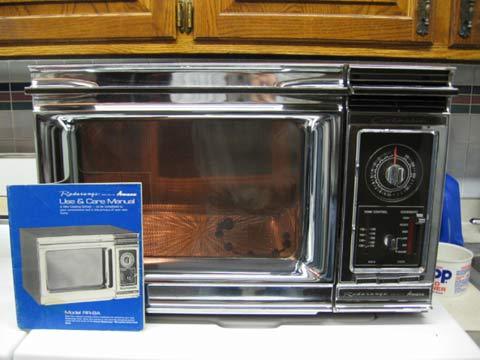
From the quick glance I got of the movie’s microwave, I am somewhat convinced it is actually the exact same model my parents had. The picture above is the model we had.  The photo doesn’t do the size of this thing justice though. It was the size of a large cooler and had to weigh over 50 pounds. If you ask my mom, the weight served as a testament to its trustworthiness.  "Built to last", you know?

How do I know what kind of microwave my family used in the late 1970s and early 90s? Because it was the exact same microwave used in our household until 2009 or so. That’s right, we used the same Amana microwave for over 30 years.  The only reason we ever abandoned the thing is because my mom eventually moved in with my sister, who had her own microwave, likely manufactured in the last ten years.  Mom fought valiantly to convince Debbie the Amana was the superior machine, but my sister won this particular battle.

As Dolores will gladly explain to you, modern microwaves simply didn’t heat up food like the ole Amana did. I have tried to explain to her it is likely because that machine was using now-banned radiation technology.  It is difficult to describe exactly the kind of noises this microwave made when it was in action.  I know most microwaves produce a hum or a whir while heating things up, but this was different.  It had the cadence of an alarm, as it’s noise would rhythmically wax and wane.  The nature of the sound wasn’t a buzz or a ringing though. Instead, it was like a goat in heat, slowly dying, bleating his last painful thoughts a couple seconds at a time.

The family would joke to Mom that no one should stand in front of the microwave for long stretches without a lead apron, but she refused to give it up.

“The repairman was shocked it was still in such good condition,” she’d brag.  “He said he would fix any problems because of the novelty of getting to work on such a great machine.” We’d debate if he really said “great” and wasn’t instead using an adjective like “old” or “Smithsonian-eligible”.

I would also try to point out to her how difficult it was to follow any sort of timing instructions using our old microwave.  You see, the timer was just a large dial with hash marks.  Every six or seven hash marks, one would be labeled with a number.  I tried numerous times to figure out what these intervals of time represented, as they definitely weren’t minutes.  Putting the timer on the first hash mark yielded around 15 seconds of nuking.  Moving the dial to the “1” amounted to around 90 seconds.  So, if the microwaving instructions included any specific intervals of time, a secondary watch or timing device would need to be brought into the operation.

And God forbid there was a temperature indication for your food.  The temperature was controlled by a lever.  At the top of the lever, the machine read “HIGH”, at the bottom “LOW”. However, these also didn’t jive with the way other microwaves seemed to calibrate temperature.  If you selected the lowest setting, it was almost like a breezy summer night inside that thing.  Lukewarm air circled around your food, effectively accomplishing nothing, imbibing with the general notion of warmth, but not really warming it up at all.

Dolores though, she was the microwave whisperer.  She had her daily snacks down to a science.  She could warm up a biscuit, heat a piece a pizza, or melt butter without having to reset any of the dials.  When we suggested our problems with the machine, she was always ready with an answer.  She never tried to make the microwave be something it wasn’t.

“Jessica, you know that you should never pop popcorn based on the instructions. You know you stand by the microwave the entire time and wait to see when the popping noises start to trail off. Oh God, you aren’t leaving the corn to pop unattended, are you?”

In other words, the problem was her careless daughter, not this mammoth-sized machine from 1977. She knew you can’t make the microwave something it isn’t. Rather than think about what it couldn’t do, she focused on what it could do.  It is a character trait I could certainly stand to possess a little more of in my own life. I’ll even give her this–when I went away to college and started using a microwave that didn’t predate my birth, there was no transcendent moment where I thought, “This! This is what I’ve been missing!”  The timer was nice, but she was right, the center of the food never tasted quite as warm as it should have.

I actually think I can bring this little story full circle. Director David O Russell’s movies as of late have been all about reinvention.  The whole focus of American Hustle is how these characters present versions of what they aren’t, what they want to be. Everyone is trying to change, improve, and be different from what they were before.  This is great, and an endeavor I’ve pursued myself.  However, it is nice to have Dolores around to remind me there is something to be said for being okay with the way things are. Mom isn’t going to fall for the latest fad or be conned into believing something is better just because it is new.  You can remove the knobs and add some buttons, but, at the end of the day, it is still a science oven.

Golden Prognosticating

Figured before the ceremony starts, I’d actually commit to some picks and see how rusty my awards season predictions are. I’m running out of time, so don’t have much commentary to offer, unfortunately. Predicted winners in bold (Thanks LA Times for the info on the nominees):

Motion Picture, Drama
12 Years a Slave
Captain Phillips
Gravity
Philomena
Rush

Motion Picture, Musical or Comedy
American Hustle
Her
Inside Llewyn Davis
Nebraska
The Wolf of Wall Street

Actress in a Motion Picture, Drama
Cate Blanchett – Blue Jasmine
Sandra Bullock – Gravity
Judi Dench – Philomena
Emma Thompson – Saving Mr. Banks
Kate Winslet – Labor Day

Actor in a Motion Picture, Drama
Chiwetel Ejiofor – 12 Years a Slave
Idris Elba – Mandela: Long Walk To Freedom
Tom Hanks – Captain Phillips
Matthew McConaughey – Dallas Buyers Club
Robert Redford – All Is Lost

Actress in a Motion Picture, Musical or Comedy
Amy Adams – American Hustle
Julie Delpy – Before Midnight
Greta Gerwig – Frances Ha
Julia Louis-Dreyfus – Enough Said
Meryl Streep – August: Osage County

Actor in a Motion Picture, Musical or Comedy
Christian Bale – American Hustle
Bruce Dern – Nebraska
Leonardo DiCaprio – The Wolf Of Wall Street
Oscar Isaac – Inside Llewyn Davis
Joaquin Phoenix – Her

Supporting Actress in a Motion Picture
Sally Hawkins – Blue Jasmine
Jennifer Lawrence – American Hustle
Lupita Nyong’o – 12 Years a Slave
Julia Roberts – August: Osage County
June Squibb – Nebraska

Supporting Actor in a Motion Picture
Barkhad Abdi – Captain Phillips
Daniel Brühl – Rush
Bradley Cooper – American Hustle
Michael Fassbender – 12 Years a Slave
Jared Leto – Dallas Buyers Club

Director
Alfonso Cuarón – Gravity
Paul Greengrass – Captain Phillips
Steve McQueen – 12 Years a Slave
Alexander Payne – Nebraska
David O. Russell – American Hustle

Screenplay
Spike Jonze – Her
Bob Nelson – Nebraska
Jeff Pope and Steve Coogan – Philomena
John Ridley – 12 Years a Slave
Eric Warren Singer and David O. Russell – American Hustle

Foreign Language Film
Blue is the Warmest Color
The Great Beauty

The Hunt
The Past
The Wind Rises

Animated Feature Film
The Croods
Despicable Me 2
Frozen

Original Song
“Atlas” – The Hunger Games: Catching Fire
“Let It Go” – Frozen
“Ordinary Love” – Mandela: Long Walk to Freedom
“Please Mr. Kennedy” – Inside Llewyn Davis
“Sweeter Than Fiction” – One Chance

Original Score
Alex Ebert – All is Lost
Alex Heffes – Mandela: Long Walk to Freedom
Steven Price – Gravity
John Williams – The Book Thief
Hans Zimmer – 12 Years a Slave

TV Series, Drama
Breaking Bad
Downton Abbey
The Good Wife
House of Cards
Masters of Sex

TV Series, Comedy
The Big Bang Theory
Brooklyn Nine-Nine
Girls
Modern Family
Parks and Recreation

TV Movie or Mini-series
American Horror Story: Coven
Behind the Candelabra
Dancing on the Edge
Top of the Lake
The White Queen

Actress in a TV Series, Drama
Julianna Margulies – The Good Wife
Tatiana Maslany – Orphan Black
Taylor Schilling – Orange is the New Black
Kerry Washington – Scandal
Robin Wright – House of Cards

Actor in a TV Series, Drama
Bryan Cranston – Breaking Bad
Liev Schreiber – Ray Donovan
Michael Sheen – Masters of Sex
Kevin Spacey – House of Cards
James Spader – The Blacklist

Actress in a TV Series, Comedy
Zooey Deschanel – New Girl
Lena Dunham – Girls
Edie Falco – Nurse Jackie
Julia Louis-Dreyfus – Veep
Amy Poehler – Parks and Recreation

Actor, TV Series Comedy
Jason Bateman – Arrested Development
Don Cheadle – House of Lies
Michael J. Fox – The Michael J. Fox Show
Jim Parsons – The Big Bang Theory
Andy Samberg – Brooklyn Nine-Nine

Actress in a Mini-series or TV Movie
Helena Bonham Carter – Burton and Taylor
Rebecca Ferguson – White Queen
Jessica Lange – American Horror Story: Coven
Helen Mirren – Phil Spector
Elisabeth Moss – Top of the Lake

Actor in a Mini-series or TV Movie
Matt Damon – Behind the Candelabra
Michael Douglas – Behind the Candelabra
Chiwetel Ejiofor – Dancing on the Edge
Idris Elba – Luther
Al Pacino – Phil Spector

Supporting Actress in a Series, Mini-series, or TV Movie
Jacqueline Bisset – Dancing on the Edge
Janet McTeer – White Queen
Hayden Panettiere – Nashville
Monica Potter – Parenthood
Sofia Vergara – Modern Family

Supporting Actor in a Series, Mini-series or TV Movie
Josh Charles – The Good Wife
Rob Lowe – Behind the Candelabra
Aaron Paul – Breaking Bad
Corey Stoll – House of Cards
Jon Voight – Ray Donovan

Second Verse, Same as the First

About a year ago, I took my nephew to see the first installment of The Hobbit movies with the best of intentions. Sadly, it ended up being a bit of a failure.  I assumed that would be the end of my nephew’s foray into the film world of Tolkien, so I was more than a little surprised when my sister informed me Ty wanted to go and see the second one while I was home over Christmas.

“Does he not remember how bored he was?  All the eye rolling in my direction?”

“He does. But, he also told me that, in retrospect, he liked it much more than he first realized.”

“He’s 11. How introspective about movies can he really be?”

With a subtitle like “The Desolation of Smaug”, I knew this movie was not going to be enjoyable.  This is another blog for another time, but I also tend to be least fond of the middle chapter of trilogies.  Save for Godfather II, I can’t think of any others that really stand out as my favorites and, yes, that includes Empire Strikes Back, which is easily my least favorite of the original three Star Wars flicks.

Ty, being both unaware of how the middle portions of trilogies tend to have a lot of filler and how the book “The Hobbit” ends, came into the movie with unusually high hopes.  There were some moments that lived up to his expectations.  The sequence of dwarves floating down a rapid river in barrels while defending themselves from Orcs was relatively fun.  Some of the showdown with the titular Smaug was enjoyable too.

Most of the movie though was padding–like watching a very long string of deleted scenes in the DVD special features section.  The movie opens with what you later learn is a flashback to the Inn of the Prancing Pony where presumed dwarf king Thorin Oakenshield and wise wizard Gandalf concoct their plan to take back the mountain.  If you haven’t seen Fellowship of the Ring, the Prancing Pony reference has no meaning.  In fact, even if you’ve seen the first Hobbit, this scene, which takes place chronologically before the events of the first film, is incredibly jarring and doesn’t exactly help us the audience refresh our memories about what happened in the last film.

It was only when we were driving to the theater that I realized how much refreshing I needed.  Ty was having the same problem.  I asked him to remind me what happened in the first movie. His response?

“Well you see there was this hobbit…”

(Did I mention I love the sense of humor this kid is developing?)

Less than a week after seeing the second movie, I find myself in the same boat–I can barely remember what transpired beyond what I have already described.  I know what didn’t happen though.  Smaug did not get desolated. Err..spoiler alert?

For Ty, the lack of dragon killing came as a big surprise.  When the movie reached its rather abrupt conclusion as Smaug flies out of his cave to go wreak havoc, Ty audibly yelled “what??” in frustration, as did a number of others in the audience who felt a little jipped with the whiplash pace of the final minutes.

Knowing enough about how movies are made, I had to chide Ty a little about his expectations. “You really think they are going to slay this dragon in the second movie? What would the third movie be about?  Walking back home?”

Once I put it that way, he understood, but that didn’t stop him from going on about how dull this movie was.  I didn’t disagree with him, but I did give him another lesson in how movie audiences worked as I explained what was going to happen next year:

“Yeah, buddy, it was long and boring and crappy.  Just like the first one was long and boring and crappy.  But guess what?  Now that we’ve invested six hours of our lives in this stupid, boring crap, you know what we’re doing next Christmas right?”

::silence from the 11 year old audience::

“We’re going to go see the third and final long, boring, crappy movie to find out how it ends.”

I met a man without a dollar to his name 
Who had no traits of any value but his smile 
I met a man who had no yearn or claim to fame 
Who was content to let life pass him for a while 
And I was sure that all I ever wanted 
Was a life like the movie stars led 
And he kissed me right here, and he said,

“I’ll give you stars and the moon and a soul to guide you 
And a promise I’ll never go 
I’ll give you hope to bring out all the life inside you 
And the strength that will help you grow.
I’ll give you truth and a future that’s twenty times better 
Than any Hollywood plot.”
And I thought, “You know, I’d rather have a yacht.”

I met a man who lived his life out on the road 
Who left a wife and kids in Portland on a whim 
I met a man whose fire and passion always showed 
Who asked if I could spare a week to ride with him 
But I was sure that all I ever wanted 
Was a life that was scripted and planned 
And he said, “But you don’t understand —

"I’ll give you stars and the moon and the open highway 
And a river beneath your feet 
I’ll give you day full of dreams if you travel my way 
And a summer you can’t repeat.
I’ll give you nights full of passion and days of adventure,
No strings, just warm summer rain.”
And I thought, “You know, I’d rather have champagne.”

I met a man who had a fortune in the bank 
Who had retired at age thirty, set for life.
I met a man and didn’t know which stars to thank,
And then he asked one day if I would be his wife.
And I looked up, and all I could think of 
Was the life I had dreamt I would live 
And I said to him, “What will you give?”

“I’ll give you cars and a townhouse in Turtle Bay 
And a fur and a diamond ring 
And we’ll be married in Spain on my yacht today 
And we’ll honeymoon in Beijing.
And you’ll meet stars at the parties I throw at my villas 
In Nice and Paris in June.”

And I thought, “Okay.”
And I took a breath 
And I got my yacht 
And the years went by 
And it never changed 
And it never grew 
And I never dreamed 
And I woke one day 
And I looked around 
And I thought, “My God…
I’ll never have the moon.”

Thanks, Ned Vizzini

I’ve always had a thing for libraries and book fairs.  There is something calming about walking around a bookstore, perusing the titles.  I guess the emotion I am looking for is “inspired”.  There is something about seeing the creative efforts of others beautifully bound, lined up and waiting for me to discover them.

In 2006, I went to a lot of bookstores.  I needed inspiration.  Moreover, I needed direction. As someone who is always rather keen to have a plan or a list or several plans and several lists, I was at a point in my life I didn’t expect to be at when I was 22 years old.  I had just quit my job at a notable Hollywood management company after surviving only nine months.  I called my mom, packed my bags, and moved home.

I never expected to be the person whose college plan failed so quickly. I knew in high school I was going to be a film major. There would be no undeclared for me. I was going to produce movies and I was going to be good at it, dammit.  Instead though, I was less than a year out of college, back in Kentucky, and toying with the idea of grad school, just not sure what on Earth I should be studying.

In order to pay the bills, I held a mish mash of jobs to pay my bills.  I resumed at the ole Blockbuster Video, my summer job during the college years.  I also managed to find a string of gigs as a freelance script reader now that the advent of this nifty little file called a PDF made it possible for me to do the job digitally rather than have a courier deliver screenplays to my doorstep.  I was barely scraping by both in the financial and the psychological sense.

When the Lexington Book Fair came up that fall, I went hoping some sort of divine intervention would help lead me down a path.  To be fair, I also had a lead. My best friend’s uncle is one of Kentucky’s more beloved authors, so I went to support him and chat with his wife about their new publishing venture.   That couple had always encouraged my academic pursuits and, knowing of my growing interest in the way pop culture depicted rural white people, an area similar to their efforts in the literary realm, they gave me some great suggestions about grad school.  They recommended programs, gave tips on reading material, and even loaded me up with some books I still have on my shelf.  It was great help, but I was still hesitant about my plans.  I didn’t want to fail again. I didn’t want to go to grad school because it was what I am supposed to do, only to have it not pan out into a career.  At 22, I naively thought a second false start into a career would make me some sort of middle class bum.

After a brief visit with my friendly unofficial academic advisors, I departed their kiosk and began to amble around the rest of the festival.  Authors were set up in booths hawking their wares, while panel discussions ran in nearby conference rooms.  The cookbooks and publications on UK basketball were drawing all the attention.  While I love me some food and some Wildcats, I just didn’t feel like fighting the crowds.  So instead, I slowly strolled down the aisles, never quite stopping, but slowing to glance at the titles that looked interesting.

When I came upon the cartoonish disembodied head on the cover of “It’s Kind of a Funny Story”, I actually stopped.  I had read this book for one of the production companies I did freelance reading for.  My ability to speed read led me to be their novel girl when I lived in LA.  Every Friday, the company would courier over a photocopy of an entire book.  I had the weekend to read the book, write my report, and turn it in on Monday morning.  This book, written by Ned Vizzini, had been one of my more enjoyable assignments.  Thematically similar to the popular “The Perks of Being a Wallflower”, it was a young adult story of a teen struggling with depression that fit well with the production company’s MO, so I recalled writing a favorable report.  It was like bumping into an old friend from my LA life to see this book staring back at me from the table.

My eyes glanced up to see that the guy manning the booth was giving me the once over. He offered a friendly smile and opened the door for conversation, identifying himself as the author.  “I’m Ned, if you have any questions.”

He didn’t look too much older than me. He also looked rather bored. Apparently, I was one of the few people here pulled in by the notion of teen suicide tomes moreso than the story of the 1996 Wildcat squad or books instructing me how to make the perfect bourbon ball.  Normally, I avoided these kinds of conversations with people at craft or book fairs.  I didn’t like having wares hocked at me, I preferred to shop in peaceful quiet.  For some reason though, I ended up starting up a conversation.

His table featured more than one book, which took me aback. How could someone who couldn’t have been more than 25 have accomplished so much with their life already? Here I was, alphabetizing DVDs at the Buster while this guy was on published novel number three. 

Having read his newest book, my eyes and the conversation drifted towards his first book, “Be More Chill”.  I was immediately won over, as it boasted the Today Show Book Club symbol on the cover.  You may like your Oprah Blook Club, but I’ll take a Today Show book any day.  Been a fan since college, so to check another one off my list seemed like a no-brainer.

As I looked over that one, he made the push for Funny Story. I admitted to him I had actually already read it.  As a reader, you really aren’t supposed to disclose who you work for and what projects they are considering, so I left that part out for the moment, but eventually it came up in conversation that the book was on the verge of being optioned as a film by a company different than the one I read it for, so I felt a little more comfortable to admit how I came across his work.

Even though he was the one with the optioned Hollywood screenplay, he acted as if my job was the cool one.  He asked numerous questions about what being a freelance reader entailed and how I got into it.  He asked me about what I was up to now, which were much tougher questions to answer.  I tried to succinctly explain why I failed so hard at being the next Hollywood it girl. I tried to not sound too sad that my closest connection to the movies was a DVD rental store. Basically, I tried to sound like I didn’t feel as pathetic as I did about the direction, or lack thereof, my life was headed in.

But this guy managed to do something my friends and family couldn’t.   He made me feel worthwhile and important, asking me about script reading and grad school plans.  Unlike my friends, who found my job superfluously interesting, he asked me lots of question about my process as a reader.  How did I evaluate a text?  How was my time divided up? Did I take notes in the margins? Did I write my synopsis as I went along?  What I didn’t realize at the time was that he was talking to me as if I was another writer.  It was the first time someone spoke to me as if I was a creative peer as opposed to a student.

At the time, I didn’t think much of our 20 minute chat beyond, “wow, what a nice guy.”  When I got home and glanced inside my newly-signed copy of Be More Chill though, I think that was when the light bulb went off.  “You may feel completely lost right now”, I told myself, “but this person thought what you do is worthwhile.  You had a conversation with a successful author in which you brought something to the table too.”

//instagram.com/p/iMCKHvif4O/embed/

It was the confidence boost I needed to get me out of my funk.  Shortly after that, I found a much more fulfilling job working as a Kaplan test prep instructor.  I realized I wasn’t a bad teacher.  In fact, I was kind of good at it.  I applied to Indiana University and, after a stressful sweat on their waiting list, made it into their Communication and Culture program.  I spent the rest of 2006 and most of 2007 reading everything I could get my hands on, going back over my old papers, and finding a lot of comfort and solace in the process.

Yesterday, I learned that Ned Vizzini died at the age of just 32.  Apparently it was a suicide. “It’s Kind of a Funny Story” was actually based on his own experiences in a psychiatric ward. He struggled with depression his whole life, it seems.

My heart sank a little when I found out the news.  While I certainly can’t say I knew the man, I can say that, at a time when I felt lost and frustrated and unsure if I was ever going to find my path in this world, Ned Vizzini popped into my life and gave me a little perspective.  He gave me a glimpse at what it was like to be a creative professional.  He made me feel like a life like that was something attainable.  He was probably just trying to pass the time at a boring book fair in Kentucky, but I will always remember him taking time out of his life to talk to me, inadvertently helping to steer me back in a direction at a time when I had none at all.

2001 and Done

It has been almost two weeks since I watched “2001: A Space Odyssey” and I still can’t seem to come up with much to say about beyond my initial reaction I shared on Twitter:

I want to offer more.  I want to understand what the big deal about this movie is.  I have to be honest though– I don’t get it. I’ve thought on it, I’ve read outside reviews and production backstories and, no matter the efforts, I still come to the same conclusion.  This film is one of the most god-awfully boring and useless pieces of work in American cinema history. Incomprehensible, dull, pretentious, and overindulgent, there is, sincerely, almost nothing redeemable about it.

I knew going in that I wasn’t going to like this installment of my movie project.  That is not to say I had my mind made up about the film, but to indicate that I kind of know when I am not going to dig a movie.  There is a particular breed of film I am simply not fond of and Kubrick’s works land squarely in my anti-wheelhouse.

Trust me, I’ve done my best to come around to the man. My freshman year boyfriend was obsessed with Kubrick.  Like other freshman girls eager to prove they are cool to their paramours, I tried to feign enthusiasm about movies like Dr. Strangelove and A Clockwork Orange.  But even while trying to impress a boy, a situation most every 18 year old girl will admit can get you to do some truly stupid things, the best I could manage was, “Well…those were…interesting.  Wanna make out?”

Kubrick is part of what is termed the modernist era of filmmaking.  Most of my peers, said boyfriend included, think of it as the era of the most exciting and innovative movies in history.  I can kind of understand where this is coming from. My fellow film school nerds appreciate the visual and technical innovations. They are won over by the overt formalism, whereas I am generally displeased with films that draw attention to their filminess.  I realize this is largely a taste issue, but let me make my case briefly for why I am just not a fan of movies made from 1967 until around 1975 or so…

You see, I firmly believe movies are a fundamentally narrative medium. They have more in common with books than paintings.  So, I idolize the likes of Frank Capra, Billy Wilder, Stanley Kramer, Alfred Hitchcock, and William Wyler, while I find the overtly visual works of Kubrick, Francis Ford Coppola, and Martin Scorsese to be lacking too much in character and narrative to be considered canonical.  This is just me. I know others don’t feel that way and, in some instances like Scorsese, I see why they like his stuff so much.

In the case of Kubrick though, I remain perplexed.  I’ve watched a fair amount of his flicks—seven of 16 to be exact. I’ve enjoyed exactly one and a half of them.  Paths of Glory, his 1957 WWI starring Kirk Douglas, is surprisingly fast-paced, gripping, and narratively driven.  Full Metal Jacket starts out with an extraordinarily compelling first half at boot camp, but goes completely off the rails once the soldiers head to war.

My biggest problem with Stanley Kubrick is pacing.  His movies are edited with seemingly no regard for whether or not the audience is getting bored.  Even the comedy Dr. Strangelove, which comes in at a scant 94 minutes, feels like a 20 minute short film concept stretched into a feature film.  Scenes meander. In fact, in Strangelove and 2001, I almost think Kubrick purposefully includes inanely boring scenes of corporate and political bureaucracy. Perhaps he is trying to make a larger point about business and government, but I was too busy dozing off to notice.  In fact, as I noted in my Tweeting, I am also pretty certain Kubrick was allergic to plot. He seems to avoid it on purpose, leaving the viewer instead to interpret visual cues, musical choices, and editing decisions to find meaning.

The other day my friend asked what 2001 was about. I took a deep breath, thought a good thirty seconds, and came up with this synopsis:

So there are three parts. The first part is prehistoric. There are monkeys, and when I say monkeys, I mean people dressed in monkey suits the Planet of the Apes never would have touched. They do monkey things until a big limestone looking slab shows up.  Apropos of nothing, we flash forward into space for some sort of futuristic story of corporate politics that, I think, results in them going to the moon? They go, find another limestone space rock, and somehow deduce that rock is telling them go to Jupiter.  Then we reach the part of the movie people tend to know where there are two astronauts on a spaceship run by a supercomputer named HAL.  HAL makes some sort of mistake in his calculations, which isn’t supposed to happen, so the astronauts decide to shut him down. HAL figures out the plan, goes on a murdering spree, and kills all but one guy before biting the technological dust. This last guy gets to Jupiter and finds…a big ole Victorian dollhouse? Cue montage of homey growing old in said dollhouse, then dying. But he isn’t dead. Instead, he turns into a giant space fetus who floats out in to space, gazing into the distance.

I would’ve prefaced this rant with “SPOILER ALERT”, but as you can see, there isn’t exactly any action to spoil.  When my friend BJ Nemeth, who I enlisted to watch with me to ensure I wouldn’t turn it off, tried to explain what was going on, he frequently referred to the book version of the story. I’m sorry, but if I have to read a book in order to understand what is happening in a movie, this is simply not a well-made movie. It isn’t like the book helps you to glean an interesting new interpretation of the film you may not have seen upon first viewing, oh no, the book is required for you to understand what the hell is even going on.

So I guess the point of this not that I hate Kubrick and I will never come around to him, though that is very likely true.  The point is, as a film scholar, I find it perplexing that this particular director who is so revered seems to me to be truly bad at his job.  Unlike Alfonso Cuaron, David Fincher, and Christopher Nolan, directors I also generally dislike, I can’t see in Kubrick what it is that other people see.  I’ve spent countless hours over the past 12 years trying to figure it out to no avail.  I can’t fake it. Maybe it makes me less of a film aficionado than I make myself out to be. Maybe it is just a freak cultural blind spot. Or maybe a movie about dollhouse, Jupiter, and space fetuses might just be that overrated.

The Home Stretch

Almost a year ago, I decided to challenge my movie knowledge.  Back in January, I thought I knew about old movies. I thought I had seen the classics. Eleven months later, I am fully aware how wrong I was.

When my movie resolution project started, I set out to watch 66 movies on this list of 116.  It seemed daunting, but thanks to TCM’s 30 Days of Oscar and some massive expansion in the streaming offerings on Netflix and Amazon, it proved to be a little too easy.

So I decided to up the ante, consulted another list, and added 38 more titles to the quest.  Since then, the summer at the WSOP and a hectic travel schedule has slowed my lightning-fast pace of the early months, but, here I am, on December 2nd, and I just have six movies to go.  As I type, I am checking the Bing Crosby and Bob Hope vehicle “Road to Morocco” off my list. As the proejct intends, it is a movie I likely would have never gotten around to without a little prodding, but now I can say I have seen at least one of the “Road to” series I have heard about before.

It will be my 96th movie of this project.  Once the final goal is reached, that number will be 102.  Of those, there were some big, big hits, like Boyz N the Hood, which ended up being an all-time favorite.  Then there were some duds, like Nashville, which I couldn’t even manage to finish.  Here is what I have watched so far ranked from favorite to least favorite. To give you a quick breakdown,  I would saw 1-10 were exceptionally good, but the top 30 were all hits in my book. From 30-50, we have movies that weren’t bad, but weren’t ones I need to see again. The next 25 or so aren’t terrible, but it was less than fun to get through to the end and cross them of the list, while the final twenty were more or less bad, with the last five or so being borderline unwatchable:

1. Boyz N the Hood
2. The Great Escape
3. Ace in the Hole
4. The Blackboard Jungle
5. Good Night, and Good Luck
6. Goodbye, Mr Chips
7. Pillow Talk
8. Return of the Secaucus 7
9. Cat Ballou
10. On Golden Pond
11. The Lady Eve
12. A Letter to Three Wives
13. Laura
14. The Great Dictator
15. The Quiet Man
16. Bull Durham
17. Jezebel
18. Glory
19. Lost Horizon
20. The Defiant Ones
21. The Caine Mutiny
22. Mutiny on the Bounty
23. Queen Christina
24. Requiem for a Dream
25. Out of the Past
26. Do the Right Thing
27. Mr Deed Goes to Town
28. A Raisin in the Sun
29. The Magnificent Ambersons
30. The Kid
31. Gun Crazy
32. Mrs. Miniver
33. This Is Spinal Tap
34. Invasion of the Body Snatchers
35. Saturday Night Fever
36. Dodsworth
37. The Americanization of Emily
38. The Pride of the Yankees
39. The Awful Truth
40. Stormy Weather
41. Hail the Conquering Hero
42. Cat People
43. The Life of Emile Zola
44. Terminator 2: Judgment Day
45. The Longest Day
46. Little Big Man
47. Swing Time
48. The Day the Earth Stood Still
49. A Night at the Opera
50. The Sweet Smell of Success
51. Bataan
52. Touch of Evil
53. Twelve O’Clock High
54. Around the World in 80 Days
55. Red River
56. Young Mr. Lincoln
57. From Russia with Love
58. Goldfinger
59. All That Jazz
60. Beau Geste
61. The Ox-Bow Incident
62. The General
63. Scarface (1932)
64. The Last Temptation of Christ
65. Close Encounters of the Third Kind
66. I Am a Fugitive From a Chain Gang
67. 20,000 Leauges Under the Sea
68. Lawrence of Arabia
69. The Man Who Would Be King
70. Cool Hand Luke
71. Badlands
72. The Yearling
73. Winchester ‘73
74. Fantastic Voyage
75. Fury
76. She Done Him Wrong
77. The War of the Worlds
78. Bullitt
79. Five Easy Pieces
80. Only Angels Have Wings
81. The Thin Man
82. Gilda
83. Camille
84. The Phantom of the Opera
85. Safety Last
86. The Greatest Show on Earth
87. Harold and Maude
88. Four Horsemen of the Apocalypse
89. The Cheat
90. Nashville
91. Out of Africa
92. Hud
93. Atlantic City
94. The Wild Bunch
95. Broken Blossoms

So where does that leave me?  With 56 movies to choose a lucky six from and 29 days to do it.  And what do I need from you all? Tell me if I really do need to watch 2001 before the year ends. Should one of the six slots go to yet another silent movie? Where can one even find sex, lies, and videotape these days?

This is my final plea, fellow film lovers. Help me make these last six count. Which ones are your picks?:

1. All Quiet on the Western Front
2. The Bank Dick
3. Ben-Hur (1926)
4. The Big Parade
5. Blue Velvet
6. Brazil
7. Cabin in the Sky
8. City Lights
9. Coming Home
10. Dirty Harry
11. Force of Evil
12. Frankenstein
13. The Freshman (1925)
14. Halloween
15. The Hustler
16. The King of Comedy
17. Last Tango in Paris
18. The Little Foxes
19. The Miracle of Morgan’s Creek
20. Modern Times
21. My Darling Clementine
22. The Night of the Living Dead (1968)
23. The Outlaw Josey Wales
24. The Poor Little Rich Girl
25. Porgy and Bess
26. The Scarlet Empress
27. Sex, Lies, and Videotape
28. Sleeper
29. Sons of the Desert
30. Sophie’s Choice
31. Sounder
32. Stranger Than Paradise
33. The Thing from Another World
34. Trouble in Paradise
35. 2001: A Space Odyssey
36. The Wind
37. A Woman Under the Influence
38. The Broadway Melody of 1929
39. Cavalcade
40. El Cid
41. David Copperfied (1935)
42. The Great Ziegfeld
43. The Gunfighter
44. Intruder in the Dust
45. The Little Colonel
46. The Mark of Zorro
47. Medium Cool
48. Melvin and Howard
49. El Norte
50. On the Beach
51. Rambling Rose
52. Run Silent, Run Deep
53. Sands of Iwo Jima
54. Shadows
55. Thirty Seconds Over Tokyo
56. Within Our Gates

Jesus Golf

When I made my first trip back to my hometown of Lexington, Kentucky in over two years a couple of months ago, my friend Jenny asked me what I wanted to do in my limited time there. I had two musts. First, we must go to Billys BBQ which remains, in my estimation, the best BBQ I have ever had. Second, I had to go play Jesus Golf.

To clarify, the name of the establishment isn’t Jesus Golf, it is more a name of convenience coined by locals of my generation.  In actuality, the place is part of the Lexington Ice Center, which is a venue that offers an ice rink, recreational sports league facilities, and your standard religious-themed 54-hole mini golf course.

The owners of the Ice Center are devout Christians and believe that people can have fun and get a little taste of the lord at the same time, so back when I was a kid, they built a mini golf center with three courses to choose from: Old Testament, New Testament, and miracles.

We always choose New Testament, believing all of Jesus’ finest work makes for the best course. We always realize five holes in what we want is Miracles, as all of the best parts of the Jesus narrative are on that one, while the New Testament course is a little more conceptual and esoteric.

I could go on for days about this anomalous little gem from my childhood, but instead, I will simply let the photos tell the story of what a mini golf course can accomplish with the power of the lord and a trip to the cement figurine store (Note: if you click on the “i”, you can see the captions explaining what some of these things are):

http://www.slideflickr.com/iframe/v7gBU7t8